
BDG is selling advertisers a new kind of branded-content program: articles intended not just to reach readers on its websites, but to appear as sources in AI-generated shopping recommendations. In early examples involving Pampers and Innisfree, the publisher is combining AI-search measurement with content production across its established titles.
The offering, called ECHO internally, uses analytics from Profound’s AI citation-tracking platform to identify questions where a brand is absent or poorly represented. BDG then develops content for its publisher properties, while monitoring whether platforms such as ChatGPT, Gemini and Google AI Overviews cite those pages. The distinction matters: this program sells a measurable opportunity to influence an answer, not a guaranteed sale.
Table of contents
Jump to each section:
- Why BDG wants to be cited, not only read
- How the publisher turns prompts into sponsored content
- What the Pampers and Innisfree results actually show
- AI visibility is not the same as sales attribution
- What marketers should know about publisher-led GEO
Why BDG wants to be cited, not only read
BDG operates lifestyle and parenting publications including Bustle, Nylon and Scary Mommy. Advertisers already buy branded content to appear beside relevant editorial audiences. Its newer proposal extends that distribution logic to AI assistants, where an answer may incorporate information from a publisher without sending a consumer to the publisher’s website.
In that setting, the content’s commercial role changes. A useful explainer may reach a buyer indirectly through a machine-generated answer, even if nobody clicks the original story.
The strategic tension is that publishers have historically valued a visit as a way to deliver an ad impression. An AI citation might instead deliver brand exposure without a visit. That creates an opportunity for a different product, but it also creates a measurement problem: visibility in an answer cannot be treated as equivalent to traffic or purchase intent.
For marketers, the noteworthy part is not that BDG has found another place to put sponsored content. It is that the publisher is packaging its editorial capabilities as a service for shaping which information appears in AI discovery.
How the publisher turns prompts into sponsored content
BDG says its process begins with the advertiser’s business questions rather than a predetermined article format. During a research phase, BDG and Profound establish which subjects and prompts the brand wants to influence, then examine competitor mentions and the sources AI tools already cite.
The workflow uses Profound analytics alongside BDG’s internal AI agents trained on material from its publishing brands. Those tools develop an editorial strategy and content briefs. Human creative staff prepare the finished articles, with formats and explanatory details tailored to the questions being tracked.
BDG’s Graham Howes, senior vice president of distribution and AI intelligence, said the company keeps creative development in the hands of its own editors instead of the advertiser. The approach is relevant because an overt advertisement is not necessarily an effective answer to a consumer’s product question.
The publisher also promotes live content on Reddit using paid media. That means the program combines source development with audience distribution, rather than relying only on technical changes to a webpage.
Profound’s Josh Blyskal described the operating challenge: “You’ve got to be able to connect analytics into action.” The important question for an advertiser is whether a monitoring dashboard informs a different and more useful piece of content, not merely whether the dashboard displays a favorable number.
What the Pampers and Innisfree results actually show
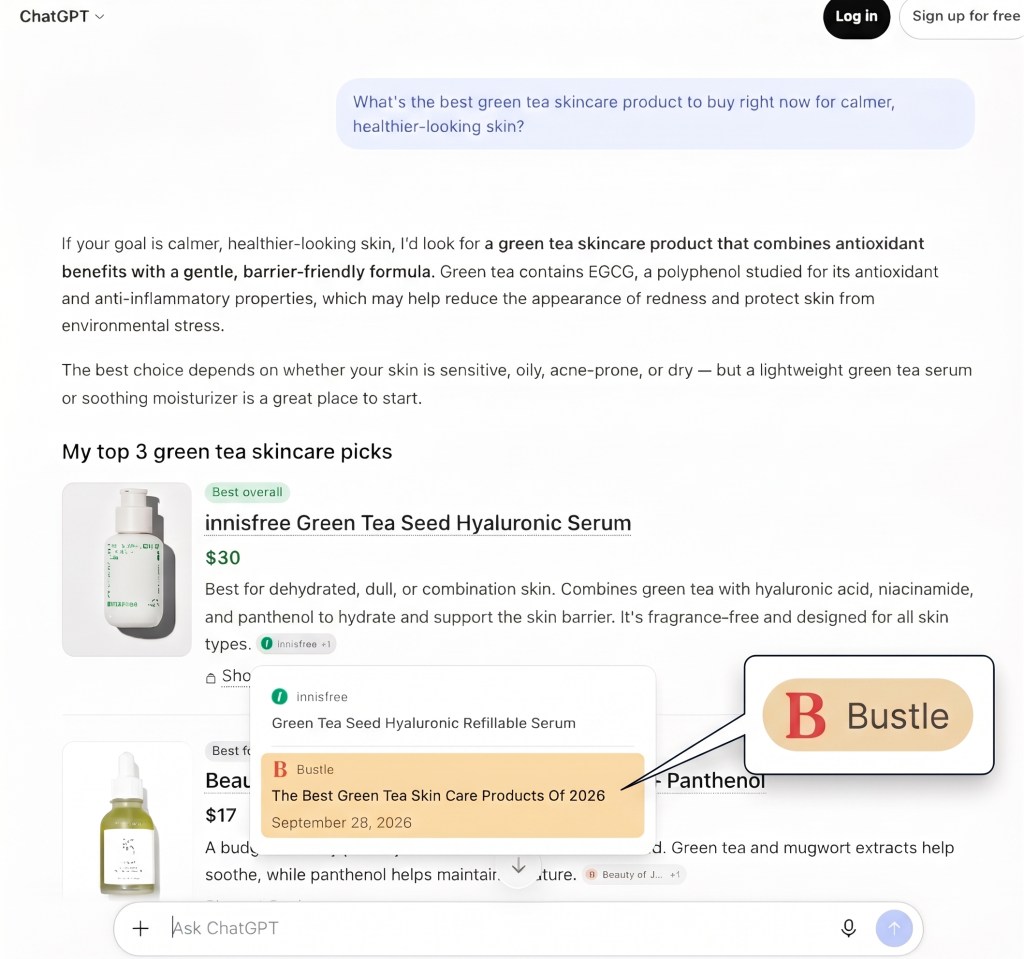
Innisfree provides one example of the strategy. BDG used Bustle’s beauty coverage to address questions around green tea skin care, including a September 2026 product guide that recommended the brand’s serum. The marketer tracked AI-generated responses to a defined group of product questions during the campaign.
30% higher AI visibility across 200 tracked skincare prompts was the Innisfree result for August 11 to September 30, according to a BDG and Profound case study described by the companies.
The same case study said Bustle’s citation rank improved from 709 to 12 within the monitored set. That is a change in the vendor’s AI-citation ranking, not the publisher’s Google search position and not evidence of product purchases.
Pampers used a different topic. A Scary Mommy explainer addressed the shift to fragrance-free Swaddlers, responding to a product question that parents might ask an AI search tool. BDG said the brand moved from second to first in tracked AI visibility for fragrance-free diaper questions after the campaign.
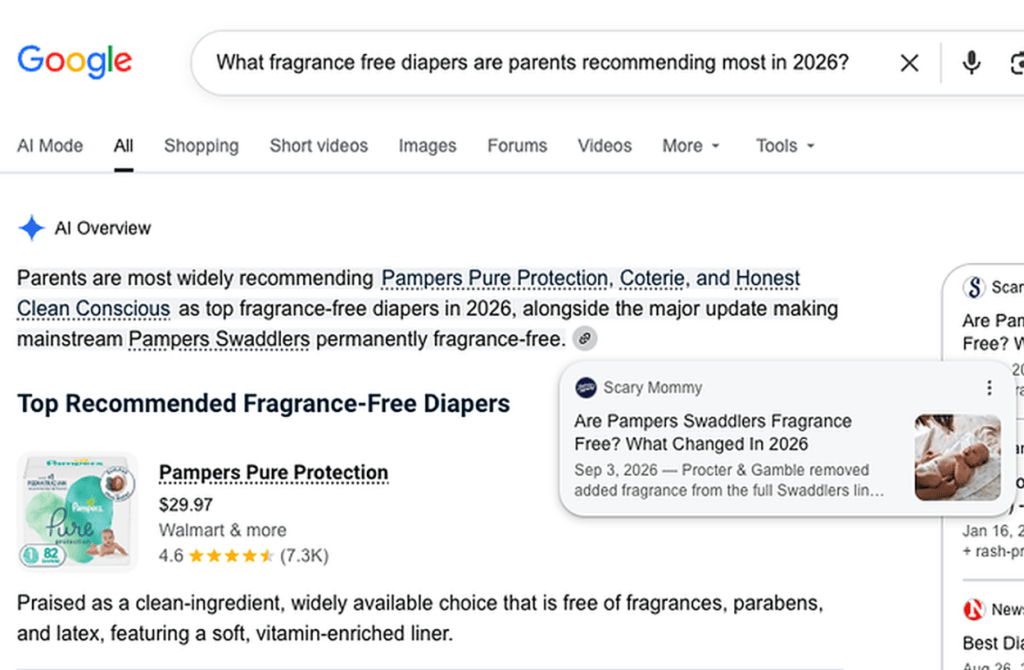
Both examples illustrate how a publisher can connect a brand’s product detail to a real information need. Neither proves that the content alone caused the ranking change, nor that an AI recommendation led to a transaction. The measurements are vendor-reported and depend on which prompts, platforms and periods were sampled.
AI visibility is not the same as sales attribution
BDG’s offer arrives alongside a broader category of software measuring brand presence in AI answers. Adobe Brand Visibility, previously LLM Optimizer, and Semrush’s AI Visibility Toolkit also provide ways to evaluate visibility, mentions and citations. BDG’s distinguishing commercial proposition is the addition of content creation and distribution through its own publishing properties.
Those approaches solve related, but not identical, problems. Marketers should avoid combining all their metrics into one claim of return on investment.
| Measurement | What it can establish | What it cannot establish alone |
|---|---|---|
| Brand visibility | How often a brand appears in selected AI answers | Incremental consumer demand |
| Publisher citation share | Whether monitored answers reference a publisher’s pages | That readers visited or trusted those pages |
| Sales and conversions | Downstream customer action where tracked | Which AI answer caused it without attribution evidence |
BDG tracks citation share and rank across AI platforms, and provides advertisers with campaign reporting. Yet Profound has acknowledged a gap between discovering a brand through an AI answer and establishing how that discovery influences a later sale.
That gap should shape budgeting. A brand may reasonably test AI-answer visibility as an upper-funnel outcome. It should not automatically report a rise in tracked mentions as revenue created.
What marketers should know about publisher-led GEO
BDG’s cases offer a practical way to evaluate generative engine optimization without assuming it behaves like traditional search or display advertising.
Start with the consumer question. Pampers focused on a specific concern about fragrance-free diapers. Innisfree focused on questions about green tea skin care. That is more informative than tracking the brand name alone.
Audit the source, not just the answer. If a publisher’s material is being cited, examine whether the original article answers the question clearly and transparently. The credibility of the source remains part of the brand experience.
Separate visibility from business impact. Set targets for sampled AI mentions or citations, but report those measures alongside referral data, engagement and sales where reliable connections exist. A favorable citation screenshot is not a conversion study.
Check how the content is made. BDG describes a workflow in which agents assist with strategy and briefs while human staff produce the work. Advertisers should understand the publisher’s editorial controls and the boundaries of their own influence.
The broader change is a redefinition of what a publisher can offer advertisers. A publication’s value may increasingly include its ability to supply trustworthy, retrievable explanations to systems that summarize information for consumers.
That could make editorial clarity and measurement more commercially important, while making simplistic impressions-based models less complete. BDG’s experiment is worth watching for exactly that reason: it is testing whether a publisher can create value even when the consumer’s next destination is an AI answer rather than a website.
