
For J.Crew, familiar holiday photos have a script: everyone dresses up, gathers close and tries to look like a perfectly coordinated family. The most interesting pictures are often the ones where the relationships are a little more complicated. That is the territory J.Crew is exploring by putting two unlikely movie costars in matching winter clothes.
Filmmaker Jordan Firstman and young actor Reggie Absolom play an unexpected father-son pairing in A24’s Club Kid. Their chemistry now sits at the center of Present Company, a J.Crew holiday campaign that borrows the warmth of an old family catalog and leaves room for a sly joke. The November 17 launch turns the pair’s screen relationship into a fashion portrait, not a conventional celebrity endorsement.
Table of contents
Jump to each section:
- Why Club Kid costars fit a family holiday portrait
- Inside the 1990s catalog look
- J.Crew is making comedy part of its fashion language
- What marketers can learn from this holiday partnership
Why Club Kid costars fit a family holiday portrait
A holiday family photograph works because everyone recognizes the small rituals: someone coordinates the sweaters, someone refuses to smile on cue and someone insists the picture has to be taken again. The Club Kid connection gives these familiar rituals a different starting point.
In A24’s official description of Club Kid, a hard-partying New York club promoter discovers that he has a 10-year-old son he never knew existed. Firstman wrote and directed the film and plays the promoter, while Absolom is among the cast. The movie opened in US theaters on November 6, 2026, shortly before the holiday campaign appeared.
That premise gives the J.Crew photographs a narrative that does not need much explaining. Instead of seeing two unrelated faces in knitwear, someone familiar with the film can recognize a pairing whose closeness is both new and awkward. For a viewer who has never heard of Club Kid, the pictures can still read as a slightly unconventional family portrait.
In J.Crew’s November 17 announcement, Firstman joked that their shared wardrobe had reached the matching-sweaters stage. Absolom supplied the competitive punchline: “I think I wore everything better than Jordan.” Their exchange matters because it lets the people wearing the clothes sound like themselves, rather than asking them to deliver a stock holiday message.
The campaign does not depend on a claim that everyone watching knows the film. Its concept works at two levels: the movie provides an extra wink for people who do, while the recognizable tension of dressing together for a family occasion gives everyone else a way into the joke.
Inside the 1990s catalog look
J.Crew is using an older version of its own visual language to make that relationship feel familiar. Photographer Alasdair McLellan shot the campaign, and stylist Miyako Bellizzi dressed the cast. The imagery draws on the retailer’s 1990s catalogs, the kind of carefully composed portraits that used to make a sweater feel like part of an entire winter lifestyle.
The clothes are specific rather than interchangeable holiday props. The brand identifies Fair Isle knits, relaxed tailoring, festive pajamas and cold-weather layers among the looks. Matching sweaters immediately communicate a shared occasion. A tailored coat or patterned knit adds the texture and clothing detail that a catalog image needs to remain useful as fashion advertising.
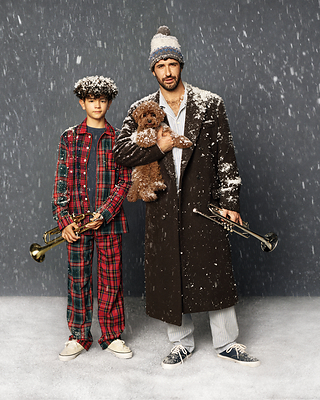
There is a productive contrast here. The clothing belongs to a familiar American retail aesthetic, while the people wearing it are associated with an independent film about a decidedly unconventional household. That gap gives the campaign its humor without requiring outrageous costumes or a complicated plot.
This is not simply a nostalgia exercise. A brand can re-create its old visual codes and end up looking like a museum of itself. By choosing contemporary performers whose public collaboration is current, J.Crew gives the catalog reference a reason to exist now. The heritage is visible in the lighting, styling and silhouettes; the reason to pay attention comes from the cast.
According to the company’s announcement, the campaign went live on November 17 across J.Crew’s digital and social channels, while the collection is available in stores and online. The verified material does not disclose campaign spending, audience reach or sales results. The photographs show the creative idea clearly, but they do not establish commercial impact.
J.Crew is making comedy part of its fashion language
The pairing is not an isolated experiment. In October, J.Crew cast comedy trio Please Don’t Destroy in We take suiting seriously, a campaign built around an increasingly chaotic shift inside the brand’s Suit Shop. The humor came from putting recognizable comic personalities in a setting where the clothes were, at least on paper, supposed to be the serious part.
The new holiday portraits operate differently. Please Don’t Destroy had a workplace sketch, a director and a sequence of escalating jokes. Present Company works more like a collection of stills with a relationship already baked in. Firstman and Absolom are not playing retail employees. They bring a character dynamic from a recent movie into familiar family-holiday imagery.
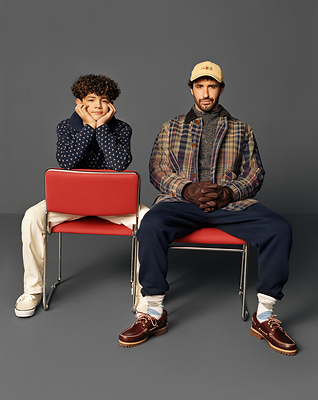
That distinction suggests a repeatable direction rather than a single celebrity booking. J.Crew can keep its recognizable wardrobe categories intact while asking its collaborators to supply a different emotional or comedic hook each time. A suit becomes funny when comedians pretend to sell it. A matching sweater becomes funny when worn by a pair whose movie relationship is not the usual holiday family story.
There are other ways to make fashion feel like entertainment. Prada’s recent holiday campaign, for instance, set famous performers alongside hand-drawn animals in a fantasy world. J.Crew’s new pictures stay closer to a familiar real-world scene. One approach builds an imagined universe; the other lets a cultural reference change how viewers read ordinary clothes.
The comparison does not establish which campaign is more effective. It does show that fashion brands do not have to choose between showing products and creating an entertaining moment. The sharper question is whether the cast, format and wardrobe belong in the same idea.
What marketers can learn from this holiday partnership
Present Company suggests that an entertainment partnership can be useful without turning an advertisement into a trailer. The film connection supplies context, but the finished photographs are still unmistakably about holiday dressing.
- Borrow a relationship, not just a recognizable face. Firstman and Absolom arrive with an established onscreen connection. Their pairing gives the matching clothes a small story before a viewer reads any caption.
- Use nostalgia as a setting, not the whole message. J.Crew’s 1990s catalog look is a clear visual reference, but the contemporary casting prevents the image from functioning only as a reproduction of an old photograph.
- Let the products participate in the joke. A matching Fair Isle sweater is funny in this context precisely because matching clothes are such a familiar holiday ritual. The wardrobe is part of the premise, not a logo added at the end.
- Keep the evidence separate from the creative interpretation. The brand has described its distribution and the talent involved. It has not disclosed verified sales or engagement outcomes for this campaign, so effectiveness remains an open question.
The deeper point is about who gets to define a brand’s heritage. A retailer can have an established look, but the people invited into that look change its meaning. J.Crew is not abandoning the catalog aesthetic; it is letting personalities from contemporary screen culture make that aesthetic slightly less predictable.
For shoppers, a holiday photo is still a picture of people wearing clothes they might buy. For someone who recognizes Club Kid, it can also function as a joke about a newly formed family. Neither reading requires the other to work, which is useful for a campaign trying to travel beyond a single audience.
If J.Crew continues this pattern, the recurring creative asset may be less about one celebrity than about the collision between classic clothes and unexpected chemistry. A familiar sweater can hold a fresh story when the people inside it make the pairing worth looking at.
